
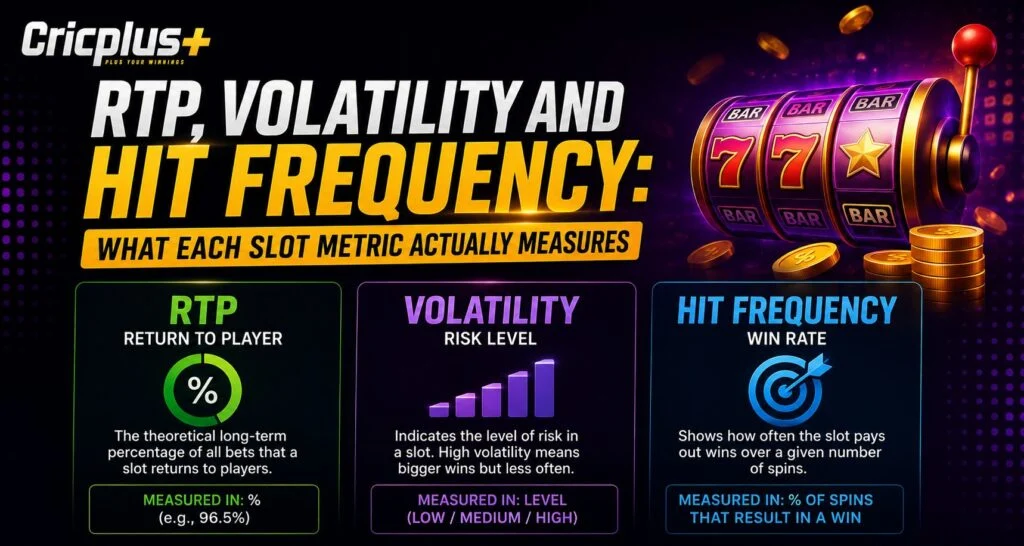
Slot games often display technical terms such as RTP, volatility and hit frequency, but these numbers describe very different aspects of a game. For users exploring casino sections through Cricplus, understanding the distinction can make game information easier to interpret. Cricplus currently lists casino and slot categories among its gaming sections, while individual game characteristics can vary by provider. Most importantly, none of these statistics tells you what will happen on the next spin.
What Does RTP Mean in a Slot Game?
RTP stands for Return to Player. It describes the theoretical percentage of total stakes a game is designed to return as prizes over a very large number of plays.
The UK Gambling Commission explains that RTP is an average measured across significant gameplay rather than a guaranteed result for an individual session.
For example, suppose a game has a theoretical RTP of 96%. Over its long-term mathematical cycle, that means the design targets an average return equivalent to 96% of total stakes. It does not mean someone who stakes ₹1,000 should expect exactly ₹960 back.
For Cricplus Login users, that distinction is essential because short sessions can finish far above or below the advertised theoretical percentage.
Why RTP Does Not Predict the Next Spin
Random slot outcomes can vary substantially in the short term.
The Gambling Commission notes that even thousands of plays may be insufficient for a random game to closely reproduce its theoretical RTP. Only over a very large volume does the averaging effect become more meaningful.
That means:
- RTP is a long-term statistical measure.
- It is not a prediction tool.
- Previous losses do not make a future win due.
- Previous wins do not reduce or increase the probability simply because a streak occurred.
- Two users playing the same slot can have completely different short-term results.
For Cricplus App readers, RTP should therefore be treated as game information, not as a guarantee of returns.
What Does Volatility Measure?
Volatility describes how variable a slot’s payouts are.
The UK Gambling Commission explains that highly volatile games can contain larger but rarer prizes, while lower-volatility games generally produce smaller prizes more frequently and more predictably. Bet365 provides a similar description, noting that low-volatility slots tend toward more frequent low-to-medium payouts while high-volatility games can produce larger payouts less regularly.
A simple comparison looks like this:
Lower Volatility
A lower-volatility game may generally have:
- More frequent smaller wins
- Less dramatic changes between spins
- Fewer very large payouts
- A more consistent payout pattern
Higher Volatility
A higher-volatility game may generally feature:
- Longer periods without significant wins
- Less predictable short-term results
- Larger potential prizes
- More irregular payout patterns
For Cricplus Live users, volatility describes the distribution of outcomes rather than the game’s overall RTP.
Can Two Slots Have the Same RTP but Different Volatility?
Yes.
Two games could both have an RTP around 96% but distribute their theoretical returns very differently.
One game might produce many relatively small winning outcomes, while another may direct a larger part of its mathematical return toward rare, larger prizes.
This is why RTP alone cannot describe how a slot feels during play. The Gambling Commission specifically distinguishes volatility from RTP when assessing how widely actual results can vary around the theoretical return.
For Cricplus Pro readers, RTP answers a long-term return question, while volatility provides information about the variation and size pattern of payouts.
What Is Hit Frequency?
Hit frequency generally measures how often a spin produces a qualifying winning result according to the game’s mathematical rules.
It is normally expressed as a percentage. For example, a 25% hit frequency would indicate that roughly one in four spins is mathematically expected to produce a qualifying hit over the game’s long-run model. It does not mean every fourth spin must win.
Game developers publish hit-frequency figures for individual titles. NetEnt, for example, lists a 23% hit frequency for Starburst and 28% for Twin Happiness, while also listing separate RTP and payout specifications for each game.
For Cricplus login readers, this demonstrates why hit frequency is a separate metric rather than another name for RTP.
Hit Frequency Does Not Tell You the Size of the Win
A high hit frequency does not automatically mean a game offers better overall returns.
Imagine two hypothetical slots:
- Slot A: 35% hit frequency with mainly small payouts
- Slot B: 20% hit frequency with less frequent but potentially larger payouts
Slot A may produce winning combinations more often, yet Slot B could still have the same or even a higher theoretical RTP.
Likewise, a hit can sometimes return less than the amount staked on that spin, depending on the game’s paytable.
For Cricplus App users, the number of winning spins and the amount returned by those wins should therefore be treated as different concepts.
RTP vs Volatility vs Hit Frequency
The easiest way to separate the three metrics is:
- RTP: The theoretical proportion of stakes returned over a very large number of plays.
- Volatility: How widely and irregularly payouts are distributed.
- Hit frequency: How often qualifying winning outcomes are expected to occur.
- Maximum payout: The highest potential award permitted by the game rules, which is another separate statistic.
Modern providers can display these values individually. NetEnt game pages, for example, separately show RTP, volatility, hit frequency and maximum payout information.
Why Game-Specific Information Matters
There is no universal RTP, volatility level or hit frequency that applies to every slot.
Individual titles can use completely different mathematical models. Players should therefore check the information or paytable inside the specific game rather than assuming one slot works like another.
Bet365 also notes that RTP and volatility information can be provided within a game’s information menu.
Cricplus Pro users should similarly treat provider-specific game information as more relevant than general assumptions about an entire casino category.
Conclusion
RTP, volatility and hit frequency each answer a different question about a slot game.
RTP describes a theoretical long-term return percentage. Volatility describes how consistent or irregular payouts may be, while hit frequency indicates how often qualifying winning outcomes are mathematically expected to appear.
For Cricplus users, the most important point is that none of these figures predicts an individual spin or guarantees a particular short-term return. RTP only becomes meaningful across very large numbers of plays, while normal randomness can create substantial differences during a single session.
FAQs
What does 96% RTP mean?
It means the game is mathematically designed to return approximately 96% of total stakes as prizes over a very large number of plays. It does not guarantee a 96% return to an individual player or session.
Is high volatility better than low volatility?
Neither is inherently better. They describe different payout patterns. High volatility generally involves larger but less frequent prizes, while low volatility usually involves smaller, more frequent results.
What does a 25% hit frequency mean?
It indicates an approximate long-term frequency of qualifying winning outcomes. It does not mean exactly one of every four consecutive spins will win.
Are RTP and hit frequency the same thing?
No. RTP measures theoretical long-term value returned, while hit frequency measures how often qualifying winning outcomes occur.
Can Cricplus Live users use RTP to predict the next spin?
No. RTP is a long-term mathematical average and does not predict individual random outcomes.