
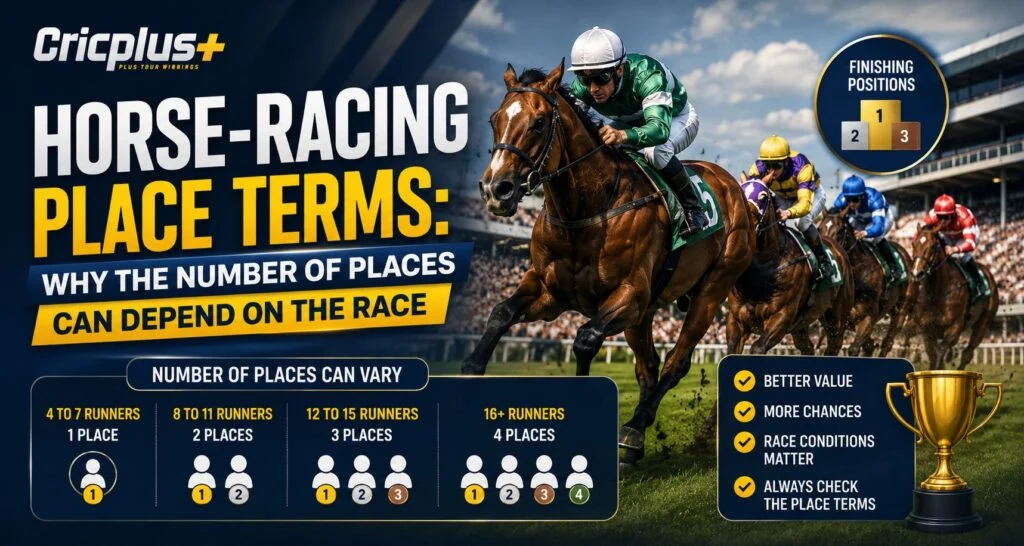
Horse racing markets include several terms that beginners need to understand before following race formats and market structures. One important concept is the “place” market, where rules can vary depending on the number of runners and the type of race. For users exploring racing information through Cricplus, understanding how place terms work can make race analysis easier and help explain why different events may have different place conditions.
What Are Place Terms in Horse Racing?
In horse racing, a place market refers to predicting whether a horse will finish within a specific position range rather than winning the race outright.
Unlike a win market, where only the first-place finisher matters, place markets cover multiple finishing positions.
For example:
- A win bet focuses on the horse finishing first.
- A place bet focuses on the horse finishing within the specified places.
- The number of qualifying places depends on race conditions and market rules.
These conditions are usually decided before the race begins and can differ between events.
Why Does the Number of Places Change?
The number of available places is often linked to the number of horses participating in a race.
Larger fields generally create more competitive conditions, which can lead to more place positions being offered. Smaller races may have fewer qualifying places because there are fewer runners competing.
Factors that can influence place terms include:
- Number of runners in the race
- Type of race
- Racing authority guidelines
- Market rules set by the platform
- Event format
Users checking information through Cricplus Login should always review the specific race conditions instead of assuming every event follows the same place structure.
How Do Different Race Sizes Affect Place Terms?
A race with many participants usually creates a wider range of possible finishing positions.
For example:
- Large-field races may offer more place positions.
- Medium-sized races may provide fewer places.
- Small-field races may have limited place availability.
The reason is simple: a bigger field creates more competition between horses, making additional finishing positions relevant from a market perspective.
Why Are Place Terms Important for Beginners?
Understanding place terms helps beginners interpret race markets correctly.
Many new followers focus only on horse names or recent performances without checking the conditions attached to a market.
Important things to understand include:
- How many places are available
- Which finishing positions qualify
- Whether the market rules change between races
- How many runners are participating
A horse finishing third may qualify in one race but not in another, depending on the official place terms.
For users following racing discussions through the Cricplus App, knowing these details can Help create a better understanding of market information.
Examples of How Place Rules Can Differ
Consider two different races:
Race A: Large Field Event
A race with many runners may offer multiple place positions because there are more competitors and greater uncertainty.
Race B: Small Field Event
A race with fewer runners may offer fewer place positions because the competition structure is different.
The important point is that place terms are not automatically the same for every race.
What Factors Should Fans Check Before a Race?
Before reviewing a horse racing market, beginners should look at several details.
Useful checks include:
- Total number of runners
- Official race conditions
- Distance and track type
- Recent horse performance
- Weather and ground conditions
- Market rules
These details provide better context than looking only at current prices or popularity.
How Place Terms Affect Race Strategy
Place markets can influence how people evaluate horses because finishing consistently in top positions becomes more important.
A horse that frequently finishes near the front may attract attention in place markets, even if it does not regularly win races.
However, previous performance does not guarantee future results. Every race depends on conditions, competition, and performance on the day.
Users exploring information through Cricplus Live should remember that race outcomes remain uncertain and require careful understanding of the available information.
Common Mistakes Beginners Make
New racing followers often misunderstand place markets because they assume:
- Every race has the same number of places
- A popular horse automatically qualifies
- Previous results guarantee future performance
- Market terms remain unchanged
Avoiding these mistakes starts with reading the full race conditions before making any decisions.
Why Understanding Race Rules Matters
Horse racing markets involve many small details that can affect how information is interpreted. Place terms are one of the most important examples because the number of qualifying positions directly changes the market structure.
A better understanding of these rules helps followers compare races more accurately and avoid confusion when different events have different conditions.
For those using Cricplus Pro for broader sports information, learning basic racing terminology can improve overall understanding of how different markets operate.
Conclusion
Place terms are an important part of horse racing because they determine which finishing positions qualify in a race market. The number of places can change depending on field size, race conditions, and market rules.
Beginners should always check the official place terms before analysing a race. Understanding these differences makes race information clearer and helps explain why two events may have completely different place structures.
Frequently Asked Questions
What are place terms in horse racing?
Place terms define which finishing positions qualify for a place market instead of only focusing on the race winner.
Why do some races have more places than others?
The number of places can depend on factors such as the number of runners, race type, and market conditions.
Does every horse race offer the same place positions?
No. Place conditions can vary between different races and should be checked individually.
Why should beginners understand place rules?
Knowing place rules helps avoid confusion and allows better interpretation of race markets.
Can a horse finish third and still qualify as a place?
Yes, depending on the specific race conditions and the number of places offered.
Are place terms related to the number of runners?
Yes. The size of the field is one of the main factors that can influence available place positions.