
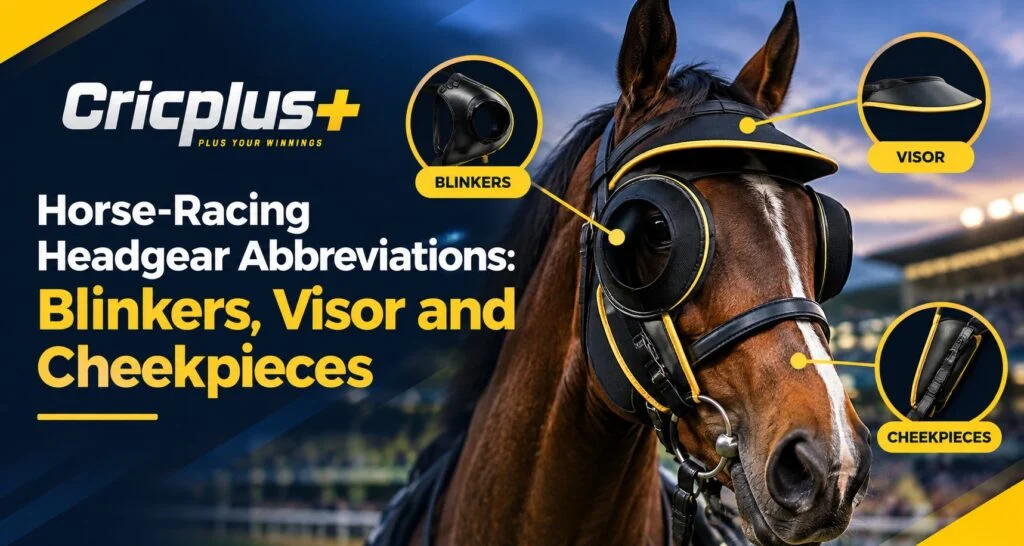
Horse racing form guides can contain plenty of abbreviations and equipment notes that may be unfamiliar to new readers. One area that often causes confusion is headgear, particularly terms such as blinkers, visor and cheekpieces.
For Cricplus users following horse racing information, understanding these terms can make racecards easier to read and provide useful context about a horse’s declared equipment. Headgear is not simply decorative; different designs can alter what a horse can see or how it responds to its surroundings.
The British Horseracing Authority (BHA) defines several forms of approved headgear and distinguishes between blinkers, visors, cheekpieces, hoods and other equipment.
What Is Horse-Racing Headgear?
Headgear refers to equipment fitted around a horse’s head during training or racing. Certain types are designed to influence the horse’s field of vision, while others may help limit distractions.
Trainers and connections may use headgear for different reasons, depending on the individual horse. A horse that becomes distracted by activity around it, for example, may be fitted with equipment that limits some peripheral or rearward vision.
Race regulations determine which types are permitted and how they must be used. The exact terminology can also vary between racing jurisdictions.
What Are Blinkers?
Blinkers are one of the most recognisable forms of racing headgear. They are fitted over the horse’s head with eye openings, while one or both sides have cups, known as cowls, that restrict vision toward the rear.
Under BHA definitions, blinkers allow forward vision while cutting out vision to the rear through the use of these cowls.
Why Might a Horse Wear Blinkers?
The intention is generally to reduce distractions from activity beside or behind the horse.
Potential reasons include:
- Helping a horse concentrate on moving forward
- Reducing visual distractions from nearby runners
- Encouraging a more focused racing attitude
- Limiting awareness of competitors approaching from behind
Blinkers do not guarantee improved performance. Their effect depends on the individual horse and how it responds to the equipment.
What Is a Visor?
A visor looks similar to blinkers, but there is an important distinction. A visor has an opening in one or both cowls that permits some limited side or rear vision.
The BHA describes a visor as similar to blinkers but with holes cut into one or both cowls, allowing limited side or rearward vision.
This makes the visor a middle ground between unrestricted vision and the more substantial restriction associated with standard blinkers.
Blinkers vs Visor
The simplest way to remember the difference is:
- Blinkers: Restrict rearward vision more completely.
- Visor: Provides limited additional side or rearward vision.
- Purpose: Both can be used to reduce distractions and influence focus.
When reading a racecard, this distinction can Help explain why a horse’s listed equipment may differ from another runner’s.
What Are Cheekpieces?
Cheekpieces are another common form of headgear. Unlike blinkers and visors, they do not use eye cups to restrict vision.
The BHA describes cheekpieces as strips of sheepskin or similar material attached around the cheek pieces of the bridle.
Because the design is different, cheekpieces can provide a different sensory effect without creating the same visual restriction as blinkers.
Why Are Cheekpieces Used?
Trainers may use cheekpieces to encourage a horse to remain focused without substantially limiting its field of vision.
They may be considered when:
- A horse is easily distracted
- The trainer wants greater concentration
- Full peripheral vision remains desirable
- A less restrictive option is preferred
Again, equipment selection is specific to the horse, its behaviour and the trainer’s assessment.
Why Does Headgear Appear on a Racecard?
Headgear information can give readers additional context before a race. The BHA notes that race officials check that horses are wearing the correct declared headgear, such as blinkers or a visor.
For someone reading a racecard, the equipment listing may therefore indicate that a horse is running with a particular setup that could affect its visual environment.
However, headgear should not be treated as a standalone prediction tool. Other factors can be much more important when assessing a race.
Consider the wider picture, including:
- Recent form
- Distance
- Going or track conditions
- Previous performance at the course
- Weight carried
- Trainer and jockey records
- Draw, where applicable
- Fitness and race experience
Can Headgear Change a Horse’s Performance?
It can influence behaviour, but the result is not necessarily positive or negative in every race.
A horse that benefits from fewer distractions may respond well to restricted vision. Another horse might perform better when it has greater awareness of surrounding runners.
This is why experienced racing observers generally look at headgear alongside the horse’s previous performances rather than assuming that one particular item automatically improves its chances.
Headgear and Changes in Equipment
A change in declared equipment can sometimes attract attention in a racecard. If a horse that previously raced without blinkers is suddenly listed with them, readers may want to investigate the reason for the change.
The equipment itself does not explain the entire story, however. Trainers can make changes for behavioural, tactical or practical reasons, and the significance can differ from one horse to another.
Users following racing information through the Cricplus Login should therefore treat headgear as one piece of race information rather than a guaranteed indicator of the outcome.
Other Headgear Terms You May See
Blinkers, visors and cheekpieces are not the only equipment terms used in racing.
Depending on the racing authority and jurisdiction, racecards may also mention:
- Hood: Covers the horse’s head and ears but does not use eye cowls like blinkers.
- Eyeshield: Covers the eyes with mesh or another transparent material.
- Eyecover: Completely covers one eye with an opaque cover.
- Sheepskin cheekpieces: A commonly referenced form of cheekpiece.
The BHA provides illustrated definitions distinguishing these different types of headgear.
How to Read Headgear Information More Effectively
If you’re new to horse racing, you do not need to memorise every equipment term immediately. Start by understanding the three most commonly discussed items:
- Blinkers – significantly restrict rearward vision.
- Visor – restricts vision while allowing some limited side or rearward view.
- Cheekpieces – provide a different form of visual and sensory influence without eye cups.
Once these basics are clear, other racecard abbreviations become much easier to understand.
Final Thoughts
Blinkers, visors and cheekpieces may look similar at first glance, but they serve different purposes. Blinkers provide stronger restriction of rearward vision, visors allow limited additional side or rearward vision, and cheekpieces offer a different approach to helping a horse stay focused.
For readers using Cricplus Live or reviewing racing information, learning these basic terms can make racecards easier to understand. The most useful approach is to consider headgear alongside form, conditions, distance and other relevant race information rather than treating one equipment change as a prediction of performance.
Frequently Asked Questions
What do blinkers do in horse racing?
Blinkers restrict a horse’s rearward vision while maintaining forward vision. They are often used to reduce distractions and encourage concentration.
What is the difference between blinkers and a visor?
Blinkers generally restrict rearward vision more completely, while a visor has openings that allow limited side or rearward vision.
What are cheekpieces used for?
Cheekpieces can be used to help a horse remain focused while allowing more visual awareness than equipment that uses eye cups.
Does wearing blinkers guarantee better performance?
No. Headgear affects individual horses differently and does not guarantee a better result.
Why do trainers change a horse’s headgear?
A trainer may change equipment because of a horse’s behaviour, concentration, racing experience or other considerations. The reason can vary from horse to horse.
Are blinkers and visors checked before racing?
In regulated racing jurisdictions, officials can check that horses are wearing the headgear they were declared to wear. The BHA specifically references checking equipment such as blinkers and visors.
Can I find headgear information in racecards?
Yes. Racecards commonly include equipment information, although the abbreviations and presentation can differ between racing authorities and publications.
Why should beginners learn these abbreviations?
Understanding headgear terminology makes racecards easier to interpret and gives readers more context about a horse’s declared equipment without assuming that the equipment alone determines the result.