
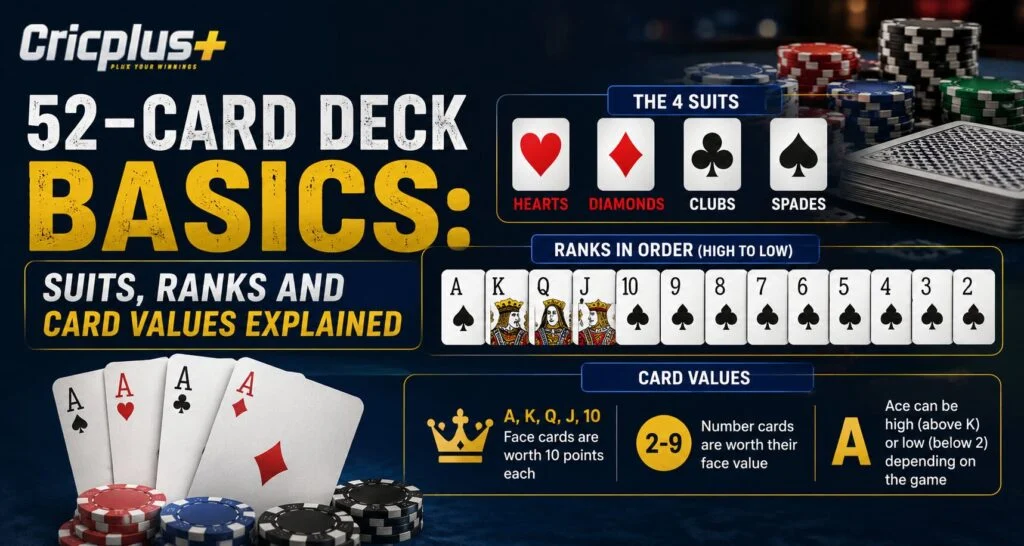
A standard 52-card deck is used in many popular card games around the world, but understanding its structure is essential before learning specific game rules. For users exploring card-based games through Cricplus, knowing how suits, ranks, face cards and numerical values work can make gameplay much easier to follow. Although different games may assign different values or meanings to certain cards, the basic construction of a standard deck remains consistent.
This guide explains the 52-card deck in simple terms, including how the cards are divided, ranked and valued.
What Is a Standard 52-Card Deck?
A standard deck contains exactly 52 playing cards. These cards are divided equally among four suits, with 13 cards in each suit.
The four suits are:
- Hearts
- Diamonds
- Clubs
- Spades
Each suit contains the same set of ranks, starting with Ace and continuing through the numbered cards and face cards.
For users accessing card games after a Cricplus Login, understanding this basic structure can help identify possible combinations and compare hands more confidently.
What Are the Four Suits?
The four suits are commonly represented by symbols.
Hearts
Hearts are represented by the ♥ symbol and are traditionally red.
Diamonds
Diamonds use the ♦ symbol and are also red.
Clubs
Clubs are represented by ♣ and are traditionally black.
Spades
Spades use the ♠ symbol and are black.
This means a standard deck contains 26 red cards and 26 black cards.
Each suit has exactly 13 cards, so no standard suit contains more cards than another.
What Are Card Ranks?
Rank refers to the identity or order of a card within its suit.
Each suit contains:
- Ace
- 2
- 3
- 4
- 5
- 6
- 7
- 8
- 9
- 10
- Jack
- Queen
- King
This creates 13 ranks across four suits, resulting in the full 52-card deck.
Users following table games on the Cricplus App may notice that the importance of each rank depends on the game being played.
What Are Number Cards?
Number cards are usually the cards ranked from 2 through 10.
Each suit contains nine number cards, meaning there are:
- Four 2s
- Four 3s
- Four 4s
- Four 5s
- Four 6s
- Four 7s
- Four 8s
- Four 9s
- Four 10s
Altogether, the deck contains 36 numbered cards.
In many games, the printed number also represents the card’s numerical value, although individual rules can change how cards are counted.
What Are Face Cards?
Jack, Queen and King are known as face cards because they traditionally display illustrated figures.
Every suit contains:
- One Jack
- One Queen
- One King
With four suits, a standard deck therefore contains 12 face cards in total.
In some games, all three face cards carry the same numerical value. In others, their rank relative to one another is more important than their numerical value.
Anyone using Cricplus Live to follow a card game should therefore check the specific game rules rather than assuming that every face card always works the same way.
How Does the Ace Work?
The Ace is one of the most flexible cards in a standard deck.
Depending on the game, it may:
- Rank above the King
- Rank below the 2
- Count as a specific numerical value
- Be used as either a high or low card
- Play a special role in certain combinations
For example, one game might treat Ace as the highest-ranking card, while another may allow it to sit below 2.
This flexibility makes it especially important to understand the rules before comparing hands.
Are Suits Always Ranked?
No. In many common card games, suits have equal value.
For example, the King of Hearts and King of Clubs may have the same rank if the game does not assign priority to suits.
However, some card games do introduce a suit hierarchy or choose one suit as a trump suit.
Users checking card-game information through Cricplus Pro should look for any rule that specifically explains whether one suit can outrank another.
How Are Card Values Determined?
Card value depends on the specific game.
A common structure may look like this:
- Cards 2–10: face value
- Jack: 10 points
- Queen: 10 points
- King: 10 points
- Ace: 1 or another specified value
However, this is not a universal rule.
In some games, cards are ranked rather than added together. In others, certain combinations matter more than the individual numbers.
That is why users should separate three different concepts:
- Card rank
- Numerical value
- Combination strength
These are not always the same thing.
How Many Cards of Each Type Are in a Deck?
A standard deck can be quickly broken down as follows:
- 52 cards total
- 4 suits
- 13 cards per suit
- 26 red cards
- 26 black cards
- 36 number cards from 2–10
- 12 face cards
- 4 Aces
- 4 Kings
- 4 Queens
- 4 Jacks
Understanding these numbers is also useful when learning basic probability in card games.
Why Should Beginners Learn the Deck First?
Learning the deck structure makes it easier to understand more advanced concepts later.
Beginners can benefit by learning:
- Which cards belong to each suit
- How ranks are ordered
- How many copies of each rank exist
- The difference between face cards and number cards
- When an Ace is high or low
- Whether suits matter in a particular game
Once these basics are familiar, individual card-game rules become much easier to understand.
Conclusion
A standard 52-card deck contains four suits, 13 ranks and an equal distribution of red and black cards. The numbered cards, face cards and Aces can take on different meanings depending on the game being played.
The most important thing to remember is that deck structure stays consistent, but card values and ranking rules can change. Learning the basic 52-card layout first gives beginners a strong foundation for understanding a wide variety of card games.
Frequently Asked Questions
How many cards are in a standard deck?
A standard playing-card deck contains 52 cards.
How many suits are there?
There are four suits: Hearts, Diamonds, Clubs and Spades.
How many cards are in each suit?
Each suit contains 13 cards.
How many face cards are in a deck?
There are 12 face cards: four Jacks, four Queens and four Kings.
Is the Ace always the highest card?
No. The Ace can be high, low or assigned another value depending on the rules of the game.
Are Hearts stronger than Clubs?
Not normally. Most games treat suits equally unless the specific rules create a suit ranking or trump suit.